Okay, folks. So. Tumblr’s jumped the shark in a big way, and I’m not even just talking about indiscriminately blocking all “adult” content on a platform that IS, in fact, primarily 18+.
Many blogs, like the wonderful @blackkatmagic , that are not especially NSFW have vanished.
(And I for one LIKE being able to go to curated porn blogs run by actual people and have a chance of finding stuff to my taste, it was one of the things that kept me on this hellsite, but that’s another issue entirely.)
I know lots of people are talking about migrating, but none of us are sure to where yet. Pillowfort seems to be an option, some people are talking about Twitter. But for now, it’s a mess, and even if we knew where we were going, it’s often a huge process, and a lot of us have stuff on tumblr that ONLY exists there.
One possible quick solution to save your blogs, both NSFW and personal, is to import it to WordPress. I found this solution through from frantic googling on how to save an entire blog, text posts an all. There are several apps for downloading all the pictures from a tumblr, (Plently for Windows, but only a few paid ones for mac, of which Tumbelog Picture Downloader is working for me so far) but this is the only solution I’ve seen so far that allows you to save EVERYTHING. I downloaded my NSFW blog in like 10 min. My regular blog, which is significantly larger, is in the process of importing, but I don’t anticipate any problems. I will, of course, update you if I have any.
This tutorial I found worked really easily. http://quickguide (.) tumblr (.) com/post/39780378703/backing-up-your-tumblr-blog-to-wordpress
I put parenthesis around the .’s like we’re back in FF-Hell, just in case tumblr’s new thing about outgoing links kicks in. You know what to do.
To break it down, just in case:
Sign up for a WordPress.com account at wordpress (.) com/start
You’ll have to create an account, with your email, a username, and a password. They should send you a confirmation email immediately, check it, activate it, and you’re good to go.
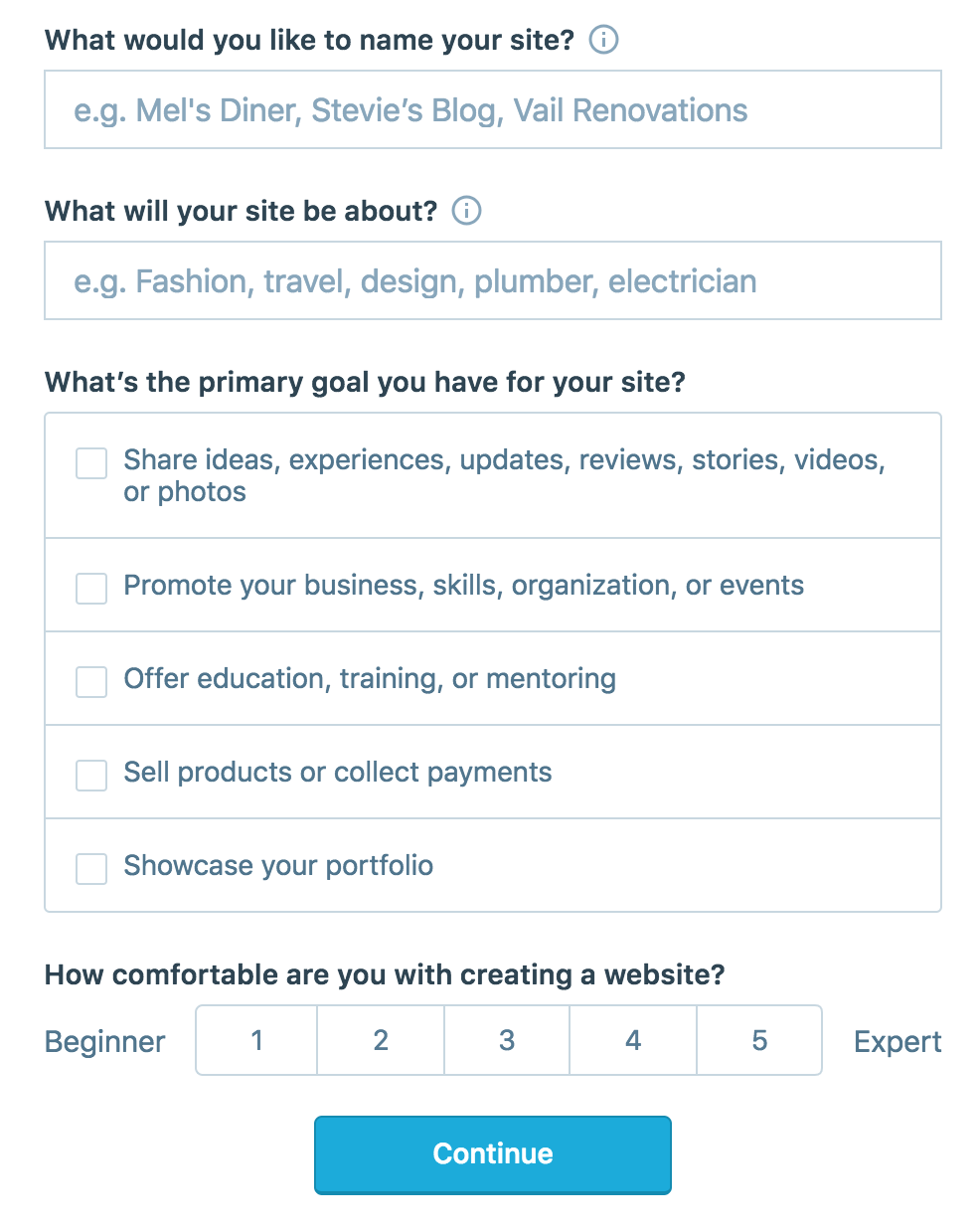
On the site, it will ask you for a site name. That page asks you a bunch of other information too, but you only have to fill out the site name.
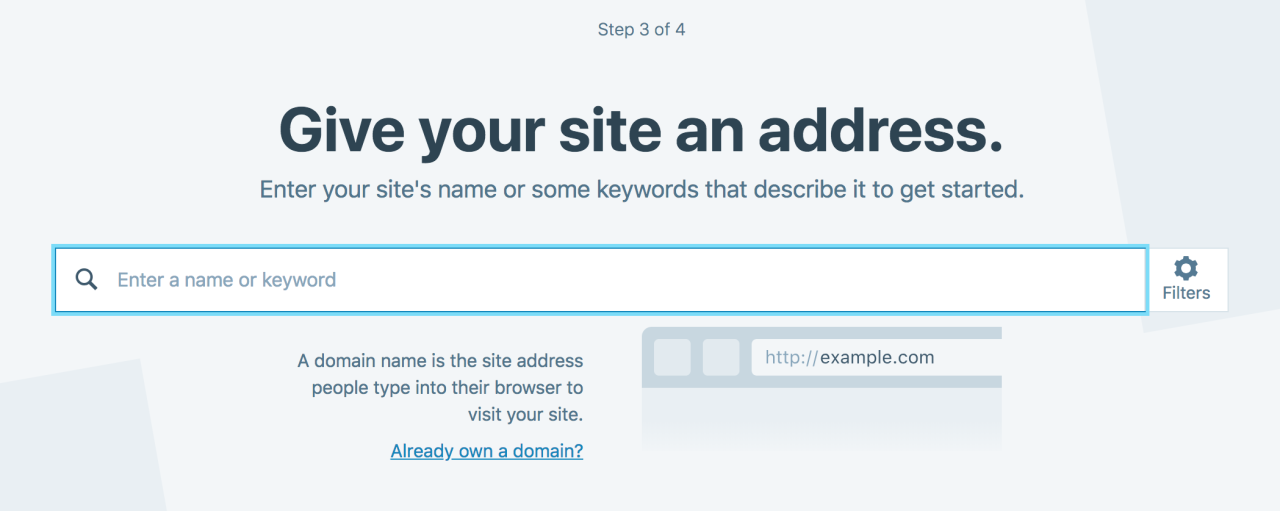
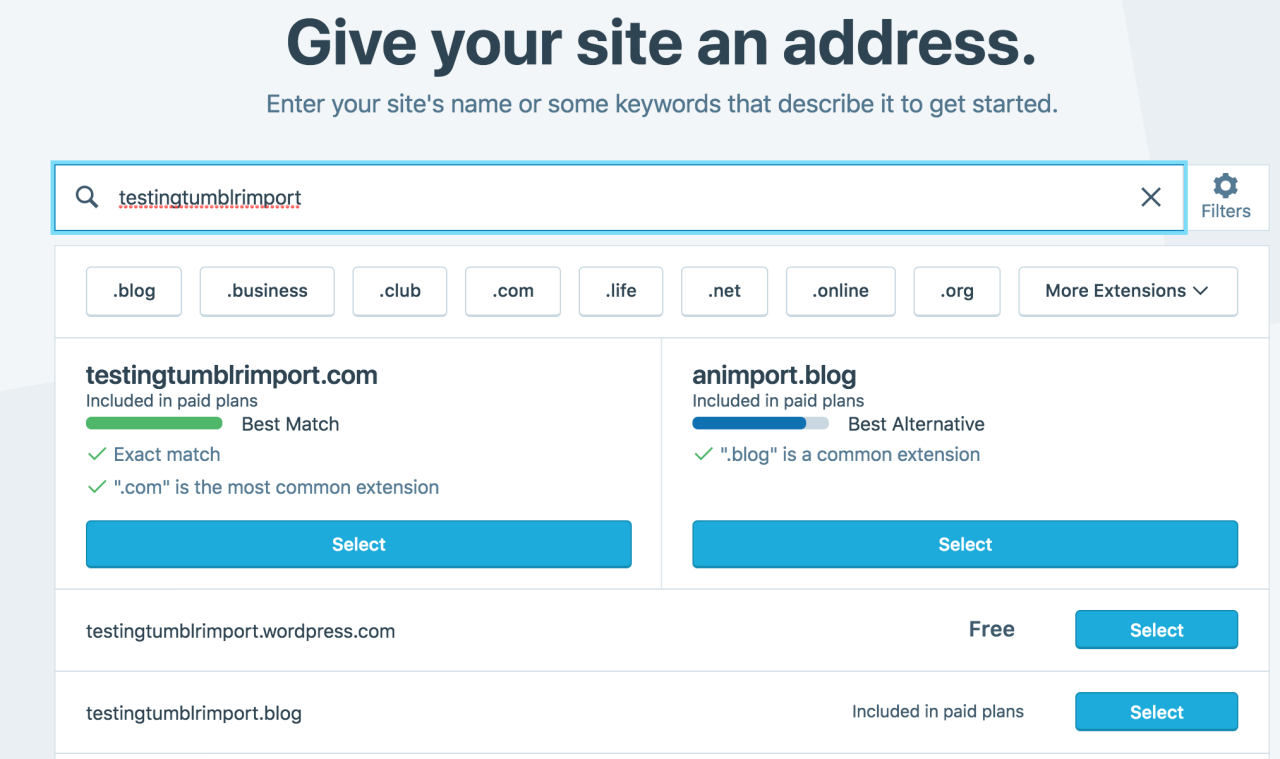
Then you have to give your site a URL. If you’re lucky, your tumblr URL is still available, if not you’ll have to come up with another one, sorry.
It will tell you if that option is still available for free.
Then it will ask you to pick a plan. Free is really good enough, I swear.
Now you’re set up! You can import your tumblr!
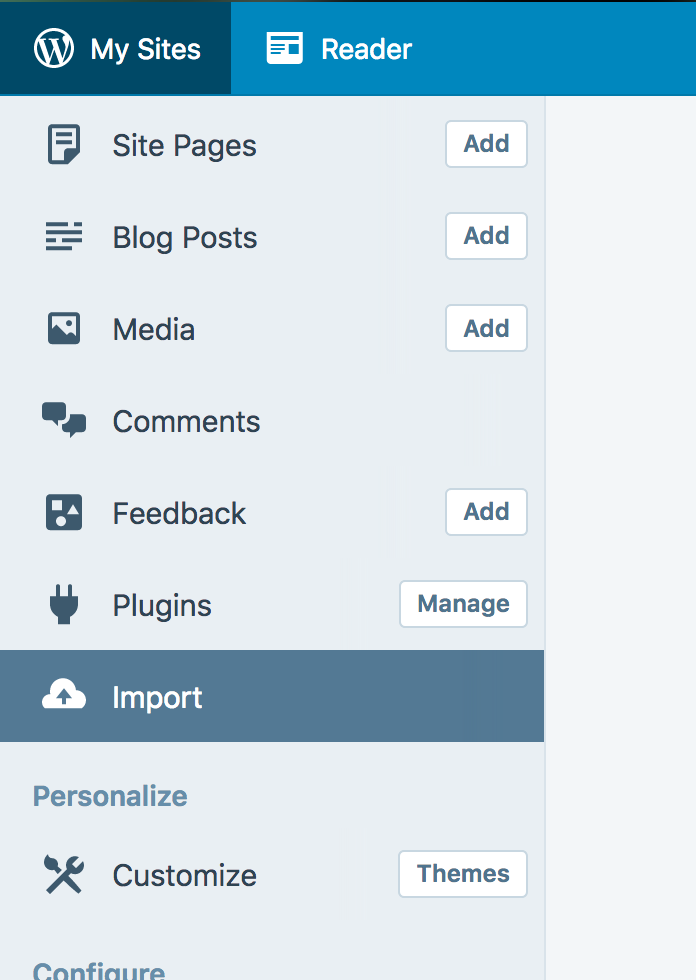
The only differences from the linked tutorial are that the Import button is now on the first level menu, not in tools.
Hit Import, then you have to follow the link for “other importers” at the bottom, to find the option for Tumblr.
Then you’ll have to sign in with tumblr, using your normal tumblr credentials. You’ll be redirected there automatically.
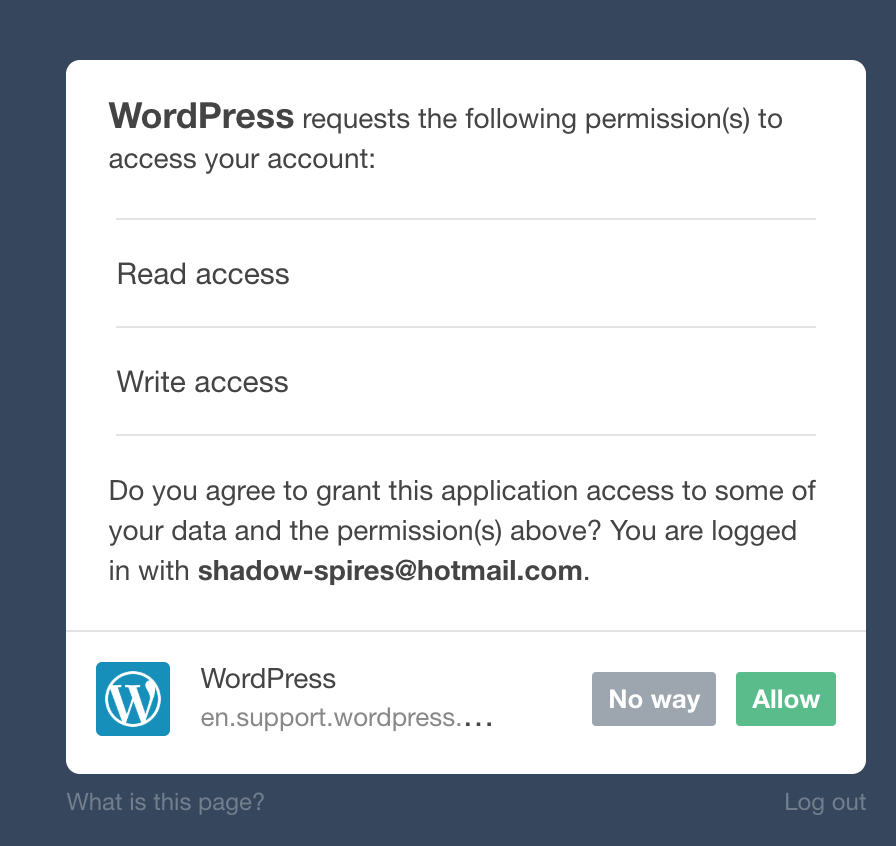
You’ll have to allow WordPress permissions on your blog.
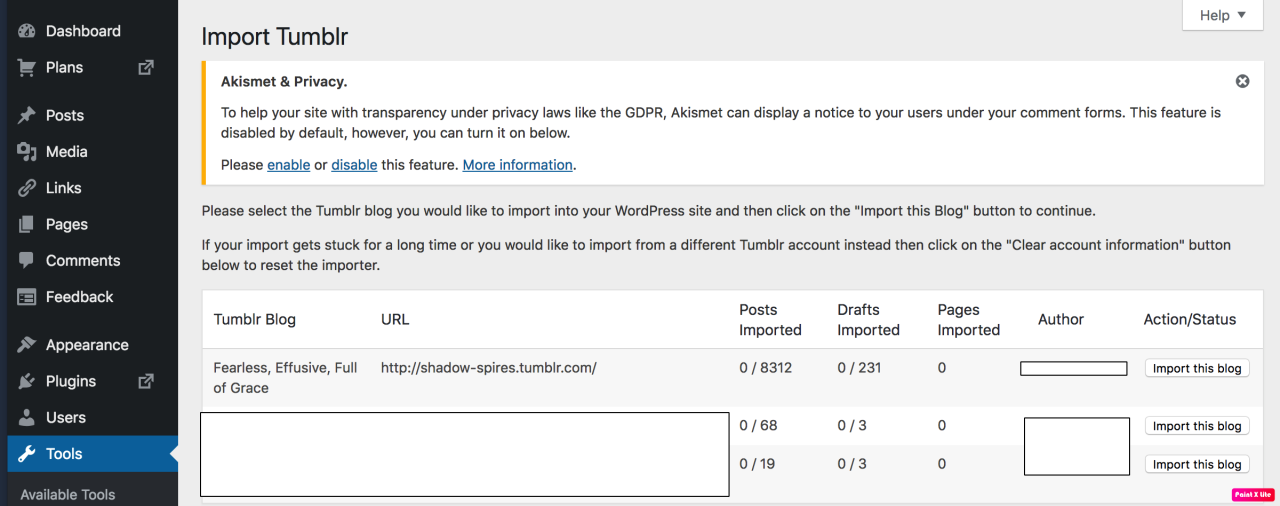
Then your blogs, including all your sideblogs, will show up in wordpress.
Hit import, wait a WHILE depending on the size of your blog, and you’re done!
ALSO!!
I made my NSFW blog private for now, since I don’t know WP’s policy on NSFW.
This means that to access it, someone has to have an account and request access. But hey, part of our problem on this hellsite has been people going places they aren’t wanted, so I don’t personally see this as a bad thing. They can send a request from the landing site on your blog, you get an email, click a link in the email, and PRESTO, they have access.
To make it private, go to Settings > Reading > Site Visibility. Go back and check, it took me changing the setting twice for it to actually stick.
tl;dr, you can import your entire blog to wordpress in just a few steps.
I’m going to tag the hell out of this, in no particular order. PLEASE reblog this and spread the word so people know it’s an option. If you’re having trouble, PM me, and I’m happy to help.
Very recently, Amazon made a small, barely noticeable
tweak to the way it sells books. And that little tweak has publishers
very, very worried.
The change has to do with what Amazon calls the “Buy
Box.” That’s the little box on the right-hand side of Amazon product
pages that lets you buy stuff through the company’s massive retail
enterprise. It looks like this:
It used to be that when you were shopping for a new copy
of a book and clicked “Add to Cart,” you were buying the book from
Amazon itself. Amazon, in turn, had bought the book from its publisher
or its publisher’s wholesalers, just like if you went to any other
bookstore selling new copies of books. There was a clear supply chain
that sent your money directly into the pockets of the people who wrote
and published the book you were buying.
But now, reports the Huffington Post, that’s no longer the default scenario. Now you might
be buying the book from Amazon, or you might be buying it from a
third-party seller. And there’s no guarantee that if the latter is true,
said third-party seller bought the book from the publisher. In fact,
it’s most likely they didn’t.
Which means the publisher might not be getting paid. And, by extension, neither is the author.
Understandably, both publishers and authors are deeply unhappy about this change.
Who gets to be the default seller in the Buy Box?
Amazon calls the default seller in the Buy Box — the one
who gets the business when a customer clicks “Add to Cart” without
looking for more options — the “Buy Box winner.” It uses an algorithm
to choose a Buy Box winner for each product it sells, prioritizing
sellers who offer low prices, use Amazon Prime, have good customer
feedback, and keep their items in stock. It also requires that items
sold by its Buy Box winners be new, not used, and only approved sellers
may compete for the Buy Box. Sometimes Amazon itself wins the Box, and
sometimes third-party sellers do.
When I asked Amazon about winning the Buy Box with regard
to books, a company spokesperson sent me this statement and requested
it be printed in full:
We have listed and sold books, both new and used, from third party
sellers for many years. The recent changes allow sellers of new books to
be the “featured offer” on a book’s detail page, which means that our
bookstore now works like the rest of Amazon, where third party sellers
compete with Amazon for the sale of new items. Only offers for new books
are eligible to be featured.
However, the Authors Guild points out
that “Amazon does not sell or stream copies of movies and television
programs that are distributed by anyone other than the authorized
distributor,” so the bookstore isn’t working exactly like the rest of Amazon. Update: After
this story was first published, an Amazon spokesperson contacted Vox to
refute the Authors Guild’s statement, noting that Amazon does allow
third-party sellers to win the Buy Box for “other physical media
categories such as DVD’s and CD’s, as well as all other categories on
Amazon” but allowing that “digital content, including ebooks, video, and
music are all licensed directly from the rights holder.”
If the author and publisher aren’t making money from book sales on Amazon, who is?
Here’s what happens to your money when you buy a book
from Amazon itself: A certain percentage of the cost goes to the
publisher. (Amazon’s terms vary from publisher to publisher, but that
share is usually around 60 percent.) The publisher uses that money to pay the author, cover its expenses, and contribute to its profit margins. Amazon pockets the remaining 40 percent for its own purposes.
Here’s what happens to your money when you buy a book through Amazon but from a third-party seller: Amazon gets
15 percent of the total sales price, including shipping, plus a flat
rate of $1.85 per item. The rest goes to the third-party seller. Not a
single cent goes to the publisher, which means nothing goes to the
author — but Amazon has made a profit either way, and without having to
shoulder the expense of shipping and warehousing.
Why aren’t third-party sellers paying publishers?
Amazon’s third-party sellers have to offer new books, not used ones, but in many cases they don’t seem to have bought their books from publishers.
No one is quite sure where their books come from, including, it seems,
Amazon itself. The industry publication Publishers Lunch reports that
Amazon third-party sellers who worry about breaking the rules have reassured one another
that they’re not doing anything wrong by citing the fact that Amazon’s
guidelines “as always, [say] nothing about provenance, nothing about
purchasing through distribution.” It doesn’t matter, in other words,
where the books come from, so long as they are new, unmarked, and sold
cheaply.
A representative I spoke to from one of the big five
publishers theorized that third-party sellers might be selling some of
the free promotional copies that publishers routinely send out to
critics and bloggers just before a book is published — not the galleys,
which are clearly marked “not for resale,” but the free promotional
copies of the finished book, which have no such marking on their covers
and often end up sold to bookstores like the Strand. Others have suggested
that they might be buying books with minor cosmetic damage from
warehouses, just damaged enough to be discounted but not so damaged that
Amazon stops considering them “new.”
Penguin Random House has confirmed on more than one
occasion that it sent a series of emails to third-party sellers
inquiring as to where and how they acquired the Penguin Random House
books they’re selling, and says it shared the results with Amazon.
Amazon, for its part, has assured the industry that it is committed to “removing bad actors.“
Hey, all I see here is that I get easy and convenient access to cheap books. How is this hurting me as a customer?
For Amazon’s customers, this policy change has a few downsides:
1. If the Buy Box winner for a book is out of
stock, it will look to most customers as though the book is out of stock
everywhere. You’ll have to click through several buttons to get to a list of all the sellers
on Amazon that carry the book and find one that’s still stocking it.
Amazon’s algorithm is weighted toward sellers that are known to keep
their books in stock, ostensibly to avoid this very inconvenience — but
judging from the frantic state of Book Twitter, a number of books appear
to have already fallen into this trap, particularly debuts.
Contrary to appearances, new copies of @AdriAnneMS and @begemotike’s SHADOW RUN are still in stock on Amazon!
In many cases, Amazon has eventually updated the Buy Box winner to
replace the out-of-stock third-party sellers, but it often takes days
for change to go through.
Just so you know, you guys, SECRETS, LIES, AND SCANDALS is NOT out of print. THIS is happening. 😦 https://t.co/16lYFocPkB
2. This policy makes it harder for publishers to make money. That makes them less likely to publish risky books. As Authors Guild president Mary Rasenberger told the New Republic,
“The connection that people fail to make is that if publishers have
less money, then they have less to invest. That means they can’t afford
to take risks on the kinds of challenging books they’ve published for
centuries.”
Exciting, artistically interesting new books are not
guaranteed moneymakers. Well-respected middlebrow books are also not
guaranteed moneymakers. Man Booker Prize nominees routinely sell as few
as 3,000 copies.
Right now publishers can afford to subsidize a few prestige titles
every year with the profits they make on the types of books that
generally do sell well — erotica that made a big splash when it was self-published, pulpy thrillers from established authors, and so on.
When publishers make less money, they have less money to
spend on interesting, valuable books that are unlikely to make a profit.
That means those books are exponentially less likely to ever make their
way to you, the reader.
3. This policy is part of Amazon’s ongoing, years-long quest to drive down the price of books. If
Amazon succeeds, fewer people will be able to make their living as
writers. That means fewer and worse books will make it to the
marketplace.
Amazon routinely takes a loss on its book sales,
often charging customers less per book than it pays publishers and
swallowing the difference. It’s a priority for the company to be your
preferred bookseller, even if it has to take a hit; its business model
can accommodate the loss, because it generally makes up the extra
dollars on the last-minute impulse buys customers toss into their
shopping carts. Meanwhile, on the e-book side of things, Amazon’s low
prices help drive sales of its Kindle. But that also means it has set
certain customer expectations: Many Amazon customers now believe that
books should be cheap — cheaper to buy than they are to make.
It is already punishingly rare for writers to make a living wage from their books.
As Amazon drives down the cost of books, it will become ever more rare.
That means fewer people will be able to invest the time and effort it
takes into becoming a writer, which means a lot of talented writers —
especially working-class writers and writers of color — will go unheard.
All of which means that you, the reader, will be missing out on some
excellent potential books.
Yikes
If you want to make sure, then click on the <X new> button below the book. You will then see all of the potential sellers.
The race to build the world’s tallest skyscraper has reached new heights – and taken a turn in direction.
Designs for ‘The Big Bend’, a slender tower that would transform Manhattan’s skyline have been unveiled.
Described as the ‘longest building in the world’, the project’s concept drawings reveal a skyscraper reaching an apex then curving back down. And featuring an elevator system that can travel in curves, horizontally and in loops.
In a bid to work around the challenges of New York’s zoning laws, design studio Oiio has imagined an innovative concept to straddle across Billionnaire’s Row on 57th Street.
what the fuck is this
It’s why people hate New York.
Oh great there’s going to be a giant fucking paperclip in my skyline. Fucking neato
It looks like you’re baiting disaster! Would you like help?
She noticed many things, sitting on her side of her fence with her cats chasing butterflies and nuzzling her ankles, Mundungus and the other watchers dropping by for tea now and then.
Mrs. Figg noticed that Petunia was a nosy bit of work with insecurities hanging from her every harsh angle. She noticed when Dudley learned the word MINE– the whole neighborhood noticed that one. She noticed that Vernon glared at owls.
She noticed that when Petunia gave Harry a truly horrendous haircut one year, it grew back in at a normal rate. Harry was uneven and weird-looking for ages, hiding under beanies when he could.
When Mrs. Figg had Harry over for carefully miserable afternoons of babysitting, she noticed nothing moved that shouldn’t. He didn’t accidentally make flowers out of fallen leaves, or levitate anything during tantrums, or turn toys funny colors.
Mrs. Figg called up her mother, interrupting the wizarding bridge game she was winning against the nursing home staff, and asked her how she had known, decades back, that her youngest daughter was a squib.
When Albus Dumbledore received Mrs. Figg’s letter he wrote back a polite thank you and then went to talk with Minerva McGonagall, who inhaled sharply in horror when he told her the news.
Finally, McGonagall gave a gathered sigh. “I suppose we can ask one of the wizarding families to homeschool him,” she said. “We can’t have the Boy Who Lived not knowing about his own world.”
“No, he’ll come to Hogwarts,” said Dumbledore.
“Hogwarts is not a place for–” Her voice fell. “–squibs, Albus.”
Dumbledore shook his head. “Harry must be taught.”
“Be taught what, Albus?”
But Dumbledore just sighed and offered her a lemon drop.
Years later, the owls and the letters came to 4 Privet Drive. The Dursleys ran, dragging Harry with them, and the letters and one stubborn gamekeeper followed– none of this would change with a magicless Harry.
When Hagrid asked Harry in that little cabin on that little rock in the middle of the sea if weird things always happened around him, Harry couldn’t tell him about vanishing glass and setting captive snakes free, about ending up somehow on the school roof, or growing his hair out overnight.
“Strange things always happen around you, don’ they?”
“Um,” said Harry, racking his brain. “Well… I live in a cupboard under the stairs…”
Harry could tell him about how snakes sometimes talked back, because that had never been Harry’s magic, but when he did Hagrid just blanched and changed the subject.
Hagrid held out hope, even against Dumbledore’s quiet warning explanations, until they made it to Ollivander’s Wands. Harry marveled at Diagon Alley, got his hands shaken in the Leaky, pressed his nose up against shop windows. Hagrid watched the scant boy– looked at James’s messy hair, Lily’s eyes, Harry’s own wandering gaze– and he wondered how this boy could be anything but magical.
In the wand shop, Ollivander said, “James Potter, yes… mahogany, eleven inches. Pliable. A powerful wand for Transfiguration.” He said, “And your mother, Lily… strong in Charms work, ten and… yes, ten and a quarter, willow, swishy.”
Harry picked up stick after wooden stick. They remained just that– wood with bits of feather or scale or hair. Harry wondered if the creatures who gave these offerings were still alive– if they were given or taken. What did it do to your wand when they died? He waved a maplewood wand (unicorn hair, eleven inches) and a gust from the door opening blew some receipts off the counter.
“Well, said Ollivander. “I think that’s as close as we’re likely to get.”
He sent them out with the maplewood. Hagrid bought Harry a snowy owl and a fudge sundae and tried not make it too obvious that these were condolence gifts. The next day the Prophet’s headlines read: The Boy Who Lived– A Squib? Various magical medical experts weighed in on how it might have happened. Fingers were pointed at childhood trauma, at his upbringing, at his family lineage.
Harry still met Ron on the train– Ron was still smudge-nosed and Harry still bought enough candy to share. When Molly had helped him through the platform entrance, her voice had been a little softer, a little more pitying– but it was still better than the laughter that had been in his aunt and uncle’s voices when they dropped him here to find a platform they didn’t think existed.
Hermione Granger dropped by their compartment, looking for Neville’s toad, but got distracted when she spotted Harry. “I’ve read about you! In my books, and in the paper,” she said. “You’re the Boy Who Lived, and you’re a squib.”
Harry sank down in his seat. Ron hid Scabbers under a candy wrapper.
“Squibs have never been allowed in Hogwarts,” Hermione announced. “According to Hogwarts, A History, squibs try to sneak in now and then– the furthest anyone’s ever gotten is to the Sorting Hat before they got found out.” At eleven, Hermione still believed in expulsion being worse than death. Her voice was thrumming with sympathetic horror.
“But they already found out about me,” Harry said, alarmed.
“It’s alright, mate,” said Ron. “You’re Harry Potter. Oy, Granger,” he added. “What’s this Hat? Fred and George were trying to sell me some story about having to fight a mountain troll to get your House…”
Harry sat back and watched the countryside rush by. Yes, he was Harry Potter– his aunt’s useless sister’s useless child, the boy in the lumpy hand-me-down sweaters who named the spiders who lived in his cupboard. And here, in new world, he was apparently useless too.
When they got to Hogwarts, Harry clenched his fists and stood in line with the other first years. He barely twitched at the ghosts or Peeves, just stared ahead and thought about how far he would get before they turned him around and sent him back to Vernon and Petunia.
They opened the Great Hall doors. They called the first years one by one. Harry clenched his teeth and walked up to the Hat when they called his name.
As he turned to sit down on the stool, he really caught sight of the Hall for the first time– the hovering candles, the big wooden tables, the black robes that swallowed the light. Translucent ghosts gossiped with the students beside them. The paintings on the far walls– were they moving?
Harry’s jaw had unclenched, falling open. His fists curled open, curving around the stool’s seat as he leaned forward to stare. If this was it, if this was as far as he’d get in this world, then he wanted to drink it all in. The candles were floating, in mid-air.
The Hat dropped down over his eyes and blocked out the light.
Well, said the dry voice that had been hollering House placements all night. What do we have here?
Ron had been begging for not-Slytherin. Draco from the robes shop had been scornful of Hufflepuff, desperate in his disdain. Neville had begged for Hufflepuff, sure he was not brave enough for Gryffindor.





 Rhio's Tunglr Stuff